- All
- Product Name
- Product Keyword
- Product Model
- Product Summary
- Product Description
- Multi Field Search

Views: 0 Author: Site Editor Publish Time: 2026-01-06 Origin: Site


In today’s fast-paced manufacturing world, precision and efficiency are everything. Acold forming die shapes metal at room temperature using force instead of heat. This process strengthens parts, reduces material waste, and ensures consistent quality in every cycle. Cold forming dies play a vital role in industries like automotive, aerospace, and heavy machinery, where accuracy and durability define success. In this article, you will learn how cold forming dies work, their main types, and how they are used across different industrial applications.
A cold forming die is a precision tool that deforms metal at room temperature using extreme pressure. Unlike hot forging, which relies on heat to soften metal, cold forming uses compressive force to mold a blank into a desired shape within a die cavity.
Property | Cold Forming | Hot Forging |
Temperature | < 200°C | > 1000°C |
Surface Finish | Excellent | Requires secondary machining |
Grain Structure | Strengthened | Often degraded |
Tolerance | High | Medium |
Energy Consumption | Lower | Higher |
Tips: Cold forming provides superior part strength and finish, especially for symmetrical shapes with tight tolerances.
In cold forming, a metal slug or wire is placed in the die cavity. A punch then exerts high force to push or pull the material into the die shape. Because the material stays below its recrystallization point, it flows plastically without melting. This process hardens the metal, improving mechanical properties.
During operation, dies endure up to 2415 MPa of compressive stress. High wear, thermal instability, and cyclic fatigue can degrade die life. Understanding how force distributes across the die helps manufacturers design shapes that reduce localized stress and extend tool service.
Notes: Die failure often results from uneven stress distribution rather than general wear.
Cold forming dies are designed to meet different production needs and part geometries. Selecting the right die type ensures accuracy, efficiency, and cost control in manufacturing.
In this method, metal flows in the same direction as the punch. It is ideal for producing solid parts such as shafts, pins, and bolts. These dies reduce friction, support high-speed forming, and deliver smooth surface finishes.
Material flows opposite to the punch, allowing the creation of hollow or thin-walled parts like sleeves and bushings. This method is preferred when light weight and structural consistency are required.
These dies combine forward and backward extrusion in a single operation. They are used for complex shapes that include both solid and hollow sections, such as connectors or stepped parts. Though more expensive, they reduce machining and improve precision.
Closed-die designs completely enclose the material, ensuring high accuracy and repeatability. They are best suited for precision components like gears and fasteners, minimizing waste and dimensional variation.
Open-die types leave part of the workpiece exposed. While less precise, they are economical for large, simple parts or preforming processes.
These dies perform multiple forming steps in one sequence. They are widely used in mass production of automotive fasteners and complex parts, improving speed and consistency.
Die Type | Typical Use | Cost Implication | Accuracy Level |
Forward Extrusion | Pins, bolts | Low | High |
Backward Extrusion | Hollow parts | Medium | High |
Combination | Complex parts | High | High |
Closed-Die | Precision gears | High | Very High |
Open-Die | Non-precision rods | Low | Low |
Multi-Stage | Automotive fasteners | High (initial) | High |
The choice of a cold forming die depends on part geometry, accuracy, and production volume. High-precision work requires closed or combination dies, while larger or rougher parts may use open dies for cost efficiency.
Punches apply force and shape the material. Long slender punches can fracture if not adequately toughened.
The insert defines the part's final shape. Complex geometries can concentrate stress and accelerate wear.
Shrink rings (often made of H11 or H13) apply compressive stress to the insert. They help resist outward pressure and maintain structural integrity.
Balanced force paths and heat-treated supports reduce fatigue. Modular die systems simplify maintenance and prolong tool life.
Notes: Pre-stressed die assemblies reduce fracture risks and allow easier part replacement.
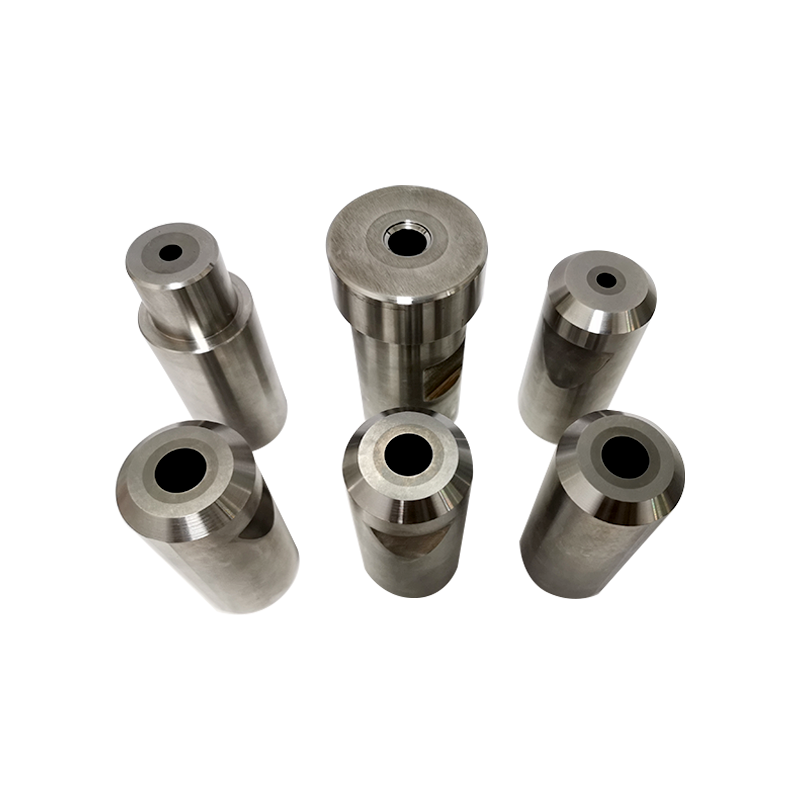
Selecting the right material is one of the most important decisions in cold forming die design. The steel type determines wear resistance, cracking tendency, and fatigue strength, directly influencing production efficiency and tool lifespan. Each steel grade provides distinct advantages suited to different forming pressures and production scales.
Cold work tool steels are the foundation of most cold forming dies. They offer high hardness, dimensional stability, and resistance to compressive stress, performing best in low-temperature forming operations.
D2 provides exceptional wear resistance and edge retention, ideal for high-wear applications. However, its low toughness makes it unsuitable for impact-heavy environments. It is best used for stable, precision forming where tool life and dimensional control are key.
A2 offers a balanced mix of hardness and toughness. As an air-hardening steel, it provides good wear resistance and excellent crack resistance. It is suitable for general-purpose cold forming and medium-volume production where versatility and reliability are needed.
O1 is oil-hardening with excellent toughness and affordability. Though its wear resistance is lower than D2 or A2, it performs well in small-batch production and lower-load applications. O1 is often used in dies that require frequent maintenance or regrinding.
High-speed steels deliver outstanding hardness and maintain strength under high pressure and heat. They are widely used for punches and inserts subject to repeated impact and friction.
M2 is the industry standard for cold forming punches. It combines high hardness with reliable toughness, retaining precision throughout long production runs.
M4 improves on M2 with higher wear resistance while maintaining similar toughness. It is ideal for continuous high-pressure operations and multi-stage forming.
T15 offers the greatest wear resistance among high-speed steels. It is used for fine, detailed dies under low-impact conditions but requires careful handling due to its limited toughness.
Hot work tool steels such as H11 and H13 are essential for structural die components. They reinforce die assemblies and resist cracking under impact or heavy load.
H11 is ductile and highly resistant to impact cracking. It is commonly used for shrink rings and die frames to absorb stress and protect internal components.
H13 provides excellent dimensional stability under repeated pressure. It combines high strength and deep hardenability, making it suitable for die holders and high-load support parts.
Choosing the correct steel grade depends on production demands, part geometry, and the expected stress environment. The following table compares key steel types in terms of wear resistance, toughness, and application suitability:
Steel Type | Wear Resistance | Toughness | Best Use Case |
D2 | High | Low | High-wear, stable-load dies |
A2 | Medium | Medium | General-purpose cold forming |
O1 | Low | High | Small-batch or fracture-prone tools |
M2 | High | Medium | High-load punches |
T15 | Very High | Low | Fine dies in stable environments |
H11/H13 | Medium | Very High | Shrink rings, die holders |
In real-world production, material choice must balance hardness and toughness. Overemphasizing hardness may cause brittle failure, while excessive toughness can reduce wear life. For example, D2 may perform poorly in impact-heavy forming, where A2 or H13 would be more durable. Conversely, O1 may last longer in low-stress, small-volume environments.
Heat treatment and surface enhancement are critical to achieving optimal performance in cold forming dies. They enhance hardness, stability, and fatigue resistance, ensuring the die performs reliably under extreme stress and long production cycles.
Effective heat treatment strengthens the steel’s structure, improving fatigue resistance and preventing deformation. Retained austenite, if untreated, can transform into brittle martensite during use. Triple tempering eliminates this unstable phase, stabilizing the die and extending its lifespan. Skipping or shortening this process can cause early cracking or sudden tool failure.
Surface hardening methods, especially nitriding, greatly improve wear and fatigue resistance. Nitriding diffuses nitrogen into the steel surface, forming a thin but strong hardened layer that prevents abrasive and adhesive wear. It works particularly well with M2, D2, and H13 steels, increasing surface hardness without distortion. When combined with proper heat treatment, nitriding can extend die life by up to three times.
When heat treatment, surface hardening, and material selection are properly integrated, the die achieves maximum strength and stability. This combination improves part output, reduces regrinding frequency, and enhances production efficiency.
Improper or incomplete heat treatment is one of the main causes of premature die cracking. Missing or shortened tempering steps directly reduce tool life and accuracy, resulting in costly downtime and part rejection.
Cold forming dies serve a wide range of industries that demand precision, durability, and efficiency. They are used to shape materials into components with high structural integrity, often at lower costs than machining or casting. Each application benefits from the process’s ability to enhance metal grain flow, minimize waste, and improve mechanical properties.
In the automotive industry, cold forming dies are used to produce bolts, gear blanks, and structural fasteners with excellent strength and uniformity. Their efficiency in large-scale production makes them essential for high-speed assembly lines.
In aerospace manufacturing, cold forming creates lightweight yet durable connectors and precision fasteners that meet stringent tolerance and safety requirements. The method’s ability to preserve metal grain structure ensures superior fatigue resistance.
For industrial machinery and hardware, cold forming is preferred for making sleeves, dowel pins, and bushings, which require dimensional consistency and material savings. The process allows mass production with minimal secondary machining.
Cold forming remains a top choice for industries focused on speed, efficiency, and mechanical reliability. Compared with machining, it delivers faster cycle times, reduced material waste, and stronger, more uniform grain structures. These advantages translate into lower per-unit costs and higher profitability for manufacturers.
Industry | Example Parts | Reason for Cold Forming |
Automotive | Bolts, gear blanks | High speed, high strength |
Aerospace | Connectors, fasteners | Weight savings, precision |
Construction | Anchors, brackets | Durability, batch efficiency |
Machinery | Sleeves, pins | Material cost savings |
Tips: Cold forming dies shine in applications where strength, volume, and consistency are essential.
Simple parts need basic die types. Complex shapes require multi-stage or combination dies.
High-volume runs justify higher tooling investment. Choose durable materials and coatings.
Select materials and design based on likely failure:
● Wear: Use D2, M4, or T15.
● Chipping: Choose A2 or H13.
● Fracture: Try O1 or S7.
Longer-lasting dies reduce downtime and scrap costs. Don’t focus only on upfront price.
Selection Factor | Preferred Choice Example |
Wear-dominant process | D2 with nitriding |
Impact-heavy application | A2 with deep hardening |
Short-run, budget tooling | O1 with minimal coatings |
Tips: Run simulations or consult suppliers to assess stress hotspots before tooling investment.
Cold forming dies are precision-engineered tools that drive efficiency and reliability in modern production. Selecting the right die type, material, and treatment method ensures high performance and long service life. From automotive fasteners to aerospace connectors, cold forming delivers durable, cost-effective, and high-volume results. Kunshan Yuntai Precision Mold Co., Ltd. provides advanced cold forming die solutions designed for strength, precision, and productivity, helping manufacturers achieve superior output and lasting value.
A: A cold forming die shapes metal at room temperature using compressive force to achieve precise forms and strong parts.
A: Common cold forming die types include forward, backward, and combination dies, used for bolts, sleeves, and precision parts.
A: Cold forming offers higher accuracy, better surface finish, and lower material waste than hot forging.
A: A cold forming die can last thousands of cycles depending on design, material, and proper heat treatment.
A: Cost depends on die type, material grade, precision level, and production volume requirements.
A: Choose a cold forming die based on part geometry, material flow, and required dimensional accuracy.